I help founders, investors, boards, and portfolio companies assess technology assets and AI economics, quantify build and run costs, expose the conditions and risks that matter, and leave with an executable plan for the next decision.

For founders · investors · boards · portfolio companies

Connect on LinkedIn

20+ years across systems engineering, cloud, DevOps/SRE, enterprise architecture, AI/data platforms, and technology leadership.

Build

What should we build, buy, or validate first—and what team, architecture, time, and budget will it require?

Automate

Can AI automate this workflow safely and economically—and where should human control remain?

Invest or scale

Does the technology asset support the business or investment thesis—and what will the next maturity step cost?

Use these services when a persuasive idea, prototype, or plan still lacks an evidence-based path to a reliable outcome.

Technology Reality Check

Decision
Should we build it, buy it, or validate something smaller first?
You receive
feasibility and constraint analysis, build/buy/partner options, cost and time ranges, capability requirements, and a focused Quick Start Plan.
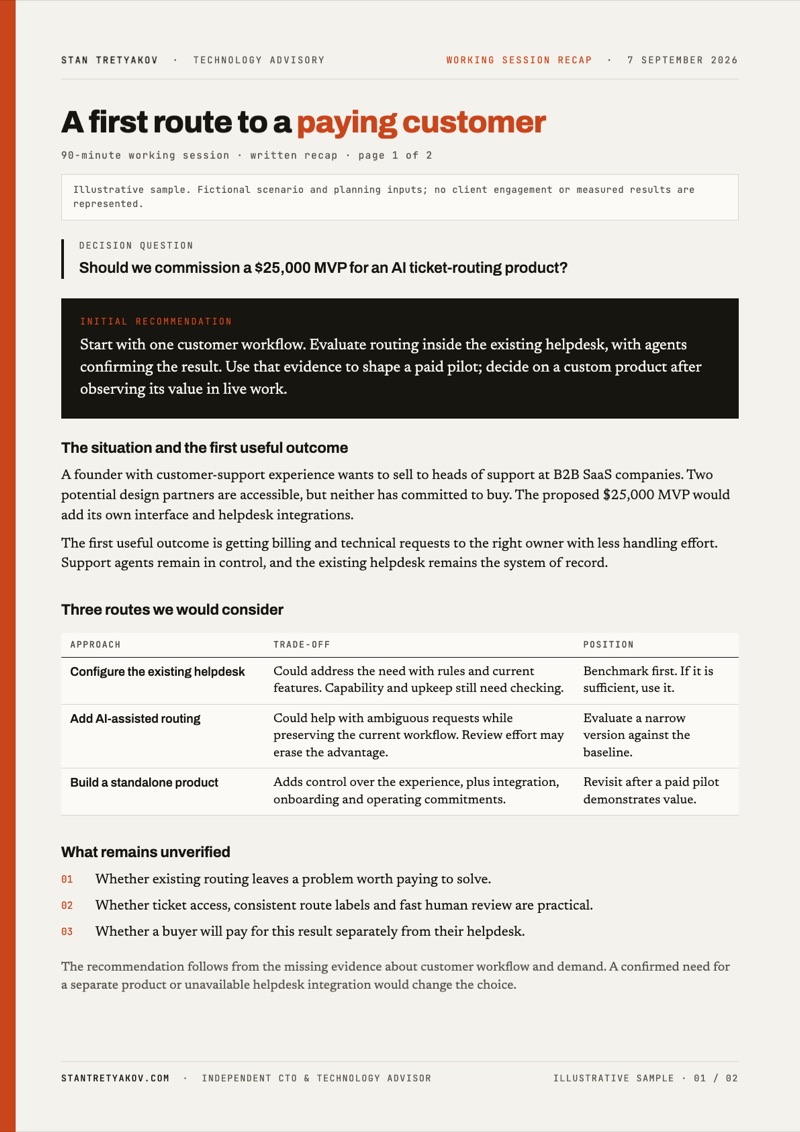
AI Automation & Economics Assessment

Featured
Decision
What can be economically automated with AI, at what autonomy level, and under which controls?
You receive
a workflow and cost baseline, Automation Opportunity Map, build/buy/augment/keep-human decisions, full cost scenarios, human-control boundaries, and pilot gates.

Technology Baseline & Economics Audit

Decision
What actually exists, where is value leaking, and what must change first?
You receive
an asset and capability baseline, architecture and operating-model findings, OpEx/TCO view, material gaps and risks, cost-to-fix ranges, and a 90-day action plan.

Technical Due Diligence Support

Decision
Does the technology asset support the value, scalability, and execution claims being made?
You receive
evidence-graded findings across architecture, product maturity, AI/data, security, delivery, team, key-person risk, and the likely cost of the next maturity step.

Interim / Fractional CTO

Decision
Who can temporarily stabilize, build, or hand over the technology function without creating permanent dependency?
You receive
a clear mandate, operating model, decision rights, team and capability plan, roadmap, metrics, risk controls, and a managed handover.

Specialist modules: AI & Platform Productization · Transaction & Fundraising Technology Readiness

Could AI agents perform this workflow reliably, safely and economically, or would conventional automation work better?

What the assessment determines

I analyse the workflow, data, decisions, integrations and failure costs to determine:

  • 01What should be automated, augmented or kept human
  • 02Where agents provide a real advantage
  • 03The limitations, risks and hidden operational costs
  • 04Expected build cost, unit economics and total cost of ownership
  • 05Required models, tools, data and infrastructure
  • 06Human approval, fallback and escalation boundaries
  • 07How to measure precision, recall, calibrated confidence and error cost
  • 08What must be proven before scaling

You receive

Agentic workflow blueprintBuild/buy/augment recommendationTCO scenariosEvaluation frameworkControl modelGated pilot plan

Everything an executive team needs to decide whether, where and how to deploy agents, and what must be proven before scaling.

Depending on scope, the engagement produces the artefacts an executive team can act on—grounded in cost, ownership, and execution rather than detached from them.

  1. 01Current-State Baseline
  2. 02Asset, Capability & Workflow Map
  3. 03OpEx/TCO and cost-to-build, cost-to-fix, or cost-to-scale ranges
  4. 04Risk, Assumption & Evidence Register
  5. 05Architecture, operating-model, and sourcing options with explicit trade-offs
  6. 06Owner, decision-rights, dependency, and control map
  7. 0730/60/90-day plan and Executive Decision Memo

The output is a decision package that executives can act on—not a recommendation deck detached from cost, ownership, and execution.

1

Frame the decision

Define the business outcome, materiality, deadline, stakeholders, known constraints, and evidence available.

2

Establish the baseline

Review systems, architecture, costs, workflows, plans, delivery evidence, and accountable owners.

3

Compare viable options

Model alternatives, dependencies, economics, risks, confidence ranges, and the consequences of doing nothing.

4

Commit the next move

Document the selected option, decision owner, assumptions, gates, and executable next-step plan.

Implementation or interim leadership can follow under a separate scope. An assessment creates no hidden obligation to retain me for delivery.

I have worked from systems engineering and cloud architecture through Technology Services leadership and CTO-level responsibility. My work connects technology choices to operating cost, delivery capacity, product validation, organizational capability, and the evidence executives and investors need to commit capital.

Cloud & DevOps capability

Built and led a Cloud & DevOps practice of 30+ engineers, developing delivery capability, technical standards, reference architectures, and advisory expertise.

Modular AI & data platform

Designed a reusable platform foundation combining a Knowledge Graph, universal modular frontend (UMFE), workflow DSL and orchestration, Bronze/Silver/Gold data layers, and governed AI assistance for rapid product and workflow experimentation.

Technology operating model

Connected business requirements, product capabilities, architecture, delivery capacity, quality, dependencies, cost, risk, ownership, and decision rights in a single operating view.

CloudPlatform EngineeringDevOps/SREEnterprise ArchitectureAI/DataKnowledge GraphsWorkflow OrchestrationTechnology EconomicsOperating Models

No. I can provide an independent assessment, support a defined decision, or temporarily own an agreed mandate. The goal is clarity and controlled capability transfer, not permanent dependency.

No credible assessment can do that before the scope, dependencies, baseline, and evidence are known. I provide ranges, assumptions, confidence levels, sensitivities, and decision gates so uncertainty can be managed rather than hidden.

Yes, when the mandate, decision rights, capacity, success measures, and commercial terms are explicit. Implementation is contracted separately.

CTO Field Notes

Early technical decisions shape the options a business will have later. I look at the cost of building a solution, operating it, and changing direction when the evidence changes. These notes explore the decisions that connect technology, customers and capital.

Start hereDecisions & Trade-offs · 3 min read

The cost of changing course

An early shortcut can become a commitment across your architecture, customer promises and team. How do you keep the next decision affordable?

Share the business outcome, current state, deadline, and the size of the decision you do not want to make on assumptions alone. I will propose a focused scope—or tell you plainly if another specialist is a better fit.

Connect on LinkedIn
LinkedIn
stanislav-t
Stanislav TretyakovIndependent CTO & Technology Advisor

Independent technology assessment · AI automation economics · Technical due diligence support · Interim/Fractional CTO

Email: stanislav.tretyakov.p@gmail.comTelegram: +381 62 941 1915WhatsApp: +381 62 941 1915LinkedIn: stanislav-t

Privacy: Contact details are used only to respond to your inquiry. Do not submit confidential source code, credentials, personal datasets, or data-room access through the public contact channel.

Scroll